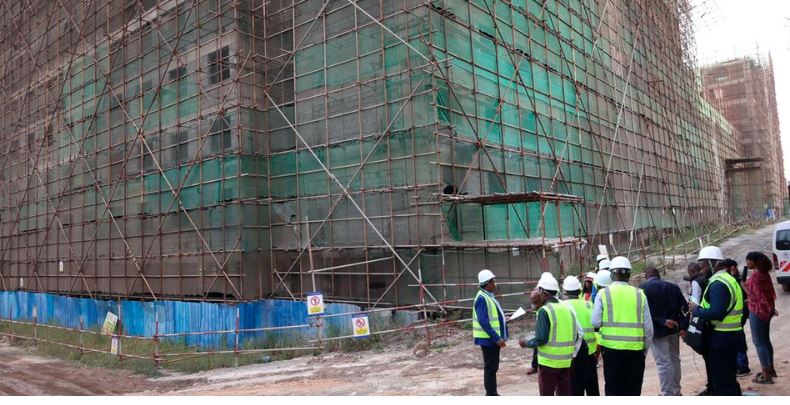
Homebuyers who invested in an affordable housing project in Ngara have raised alarm over what they describe as a stalled development and possible fraud, after waiting for more than eight years without receiving their units.
The project, linked to Jabavu Developers, was marketed as part of efforts to expand access to affordable housing within the capital. Buyers say they paid deposits—and in some cases substantial portions of the purchase price with the expectation of timely delivery.
However, construction has remained incomplete for years, leaving investors stranded and uncertain about the fate of their money.
“We were promised that the houses would be ready within a reasonable timeframe, but eight years later, there is nothing to show for it,” said one buyer. “We have kept following up, but we are only given assurances that never materialise.”
Another investor said the financial burden has continued to grow despite the lack of progress on site.
“Some of us took loans to finance these houses. We are still repaying, yet the project has stalled. It is frustrating and financially draining,” the buyer said.
According to affected homeowners, the development has seen minimal activity despite repeated commitments by the developer to resume construction.
“Every time we inquire, we are told the project will resume soon, but nothing changes on the ground,” another buyer added. “We feel neglected and misled.”
The stalled development has brought into focus concerns around accountability in off-plan property sales, particularly within Nairobi’s growing affordable housing sector. Buyers argue that weak enforcement mechanisms have left them exposed to prolonged delays and potential losses.
“We trusted the process and believed this was a genuine affordable housing initiative,” one of the buyers said. “Now we are left wondering whether we will ever get our homes or our money back.”
Ngara’s proximity to Nairobi’s central business district had made the project attractive to many first-time homeowners seeking affordable options within the city.
Affected buyers are now calling for urgent intervention from authorities to compel the developer to either complete the project or issue refunds.
“We just want transparency and a clear way forward,” one investor said. “If the houses cannot be delivered, then we should get our money back.”
The case adds to growing scrutiny of real estate developments in Nairobi, as buyers increasingly demand accountability and stronger protections in the housing market.
The demand comes two years after Jabavu Limited claimed in 2024 that the land was no longer a public property.
Previous investigations by the Nairobi City County Assembly indicated that the agreement between Jabavu Village Limited and Nairobi City County was changed by a few individuals.
“There is a likelihood that there was fraud in terms of the amendment of the actual
document. Whenever there is an addendum it means that there was an actual document
that was there before an amendment was done. We are looking at fraud in the sense that
the initial document as SPV shows that Nairobi ought to have taken 99 per cent while
the developer was to take the remaining 1 per cent. At what point did the addendum
before the government get signed that the developer has 80 per cent and the county 20
per cent? We are investigating fraud,” Nairobi South MCA previously stated.
Addressing the media in 2024, Abdulkadir Hussein, the Managing Director of
Jabavu Village (the lead developer behind the Jevanjee affordable housing project in
Ngara) said that while the land for the Jevanjee Gardens project was initially owned by
the Nairobi City County Government (NCCG), the title deed was legally transferred to a
Special Purpose Vehicle (SPV) created for the project, Nairobi Bachelors Jevanjee Estate
Limited, in 2019.
Read Also: Africa Turns to Nairobi for AUF2 on Urban Development
Why the LG Bottom Freezer Refrigerator Just Makes Sense
“The transfer of the land to the SPV means this is no longer public land. Jabavu Village
holds 80 percent of the shares in the SPV, and the NCCG holds 20 percent.” Hussein
explained.
“The Nairobi County government’s role was to provide the land, while our company was
tasked with sourcing the necessary funds.” He added.
Questions continue to be raised on whether Jabavu was suited to undertake the project as
they used the title deed of the said land to secure a Sh1.9 billion loan at the National Bank of Kenya; two years later they are yet to accomplish the project as the Assembly starts the investigations again.
The was discovery made by the Nairobi County Assembly in 2024 sparked further controversy and brought former Nairobi Governor Mike Sonko into the spotlight.
He denied allegations of holding onto the deed while accusing current officials of
misinformation.
Sonko had been accused by the Johnson Sakaja-led administration of having the title
deed for the estate under L.R No. 209/5458, registered in the Registry of Titles in
Nairobi as I.R 199739/1
However, Sonko claimed that the title deeds for both the Jevanjee and Pangani affordable housing projects are in the possession of the National Bank of Kenya.
He said the documents were charged to the bank as collateral for a Sh1.9 billion loan
that was approved for a private developer involved in the Jevanjee project.
“The title was taken to the bank as a special purpose vehicle to secure financing,” Sonko
said, adding that accusations against him were unfounded.
Earlier this week, Jabavu Limited clarified that the financing for the project was sourced
through a bank loan facility of Sh1.9 billion and that they had already been given an upfront of half a billion.
“We have so far drawn down Sh450 million against work certificates issued by the contractor and supporting consultants. The loan is being used exclusively for the completion of the Jevanjee Gardens development, and payments are made directly to contractors, architects, surveyors, and other professionals involved in the project.” Hussein explained.
On April 19, 2023, the Nairobi City County Assembly passed a motion to allow title deeds of the Nairobi Urban Renewal Projects, where the Pangani Affordable Housing Project falls, to be used as security by developers to access funding.
However, a civil society group, Sheria na Watu, filed a case with the Environmental and Lands Court on May 10, 2023, against the Nairobi City County Government and the Nairobi City County Assembly arguing that the move by the latter is unconstitutional.
The court heard that the National Lands Commission was never involved in the process
yet it is the custodian of public land. “It was contended that before the approval of the
said resolution by the second Respondent, no authorization was obtained from the third
respondent to offer the title of the intended Pangani Urban Renewal Project as
collateral, for the benefit of the developers, who are private entities.” The judgment
stated in part.
Article 62 (2) of the Constitution states that public land shall vest in and be held by a
county government in trust for the people resident in the county and shall be
administered on their behalf by the National Lands Commission.
Last week, the Nairobi City County Assembly ordered the National Bank of Kenya to
stop further transactions using the title deed for the Jevanjee housing project until the
Sectorial Committee on Lands, housing, and Planning completes its investigations.
The Jevanjee Gardens project is part of Nairobi’s broader urban renewal initiative aimed
at revitalizing old public housing estates and providing much-needed affordable housing
to the city’s growing population.
Located in Ngara, just 10 minutes from Nairobi’s central business district, the development will feature two 14-story towers, with a total of 800 residential units.
The project’s progress, however, has faced some delays due to unforeseen challenges as the completion date remains uncertain.
Hussein highlighted that initial setbacks were caused by difficulties in acquiring the land
and the global impact of the COVID-19 pandemic, which severely affected the
construction industry.
The joint venture between Jabavu Village and the Nairobi City County Government was
designed to leverage both public and private sector resources.