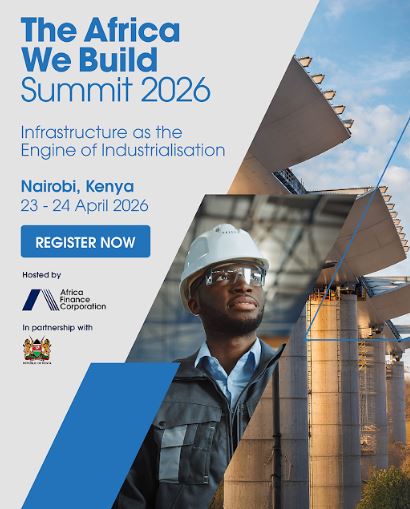
For the first time, Africa’s leading infrastructure financiers, fund managers, investors and industry leaders will convene in Nairobi in a high-level push to unlock domestic capital and accelerate the continent’s industrialisation.
The inaugural Africa We Build Summit, hosted by the Africa Finance Corporation in partnership with the Government of Kenya, will take place from April 23 to 24, 2026, bringing together decision-makers to originate bankable projects and fast-track infrastructure investments.
Held under the theme “Infrastructure as the Engine of Industrialisation,” the summit aims to shift Africa’s development model from fragmented, standalone projects to integrated infrastructure systems that support large-scale economic growth.
At the centre of discussions will be how to mobilise more of Africa’s domestic capital into commercially viable infrastructure and industrial opportunities, amid growing recognition that the continent has significant capital reserves that remain underutilised.
“Africa is not capital-poor; it is capital-trapped,” said Samaila Zubairu, President and CEO of AFC. “The opportunity now is to channel that capital into infrastructure and industry at scale—transforming resources into productivity, jobs, and long-term prosperity.”
The summit will also mark the launch of the State of Africa’s Infrastructure Report 2026, expected to provide a comprehensive analysis of investment gaps, capital flows, and priority project pipelines across the continent, with a focus on driving execution rather than policy discussions alone.
Read Also: Kenya Secures Azerbaijan Backing ahead of Africa Urban Forum 2
Africa Turns to Nairobi for AUF2 on Urban Development
Kenya’s President, William Samoei Ruto, is set to deliver the keynote address, signalling high-level political backing for regional integration and large-scale infrastructure development.
A key focus will be the development of regional infrastructure corridors, including transport, energy and logistics systems designed to connect production zones to markets. Among the flagship projects highlighted is the Lobito Corridor, which is seen as a model for linking natural resources to processing and export infrastructure.
The summit will also spotlight financing vehicles such as the Kenya National Infrastructure Fund, which are aimed at crowding in private capital and reducing reliance on external borrowing.
In East Africa, discussions will centre on strengthening regional connectivity through key trade routes such as the Northern Corridor, which links the Port of Mombasa to Uganda, Rwanda, eastern Democratic Republic of Congo and South Sudan.
Planned upgrades to road and rail networks, alongside proposals for an expanded East African railway master plan, are expected to feature prominently as governments and investors seek to lower the cost of moving goods across the region.
Another major theme will be the integration of energy and minerals infrastructure, with a growing push for value addition within Africa rather than exporting raw materials. This approach is seen as critical to building industrial capacity, creating jobs, and retaining more economic value within the continent.
The summit comes at a time when African economies are under pressure to accelerate growth, create employment, and reduce dependency on commodity exports. By focusing on bankable projects, investable pipelines and execution-driven partnerships, organisers say the meeting is designed to move beyond talk and catalyse real investments.
If successful, the Nairobi summit could mark a turning point in how Africa finances and delivers infrastructure—shifting from externally driven funding models to one anchored in domestic capital and regional collaboration.