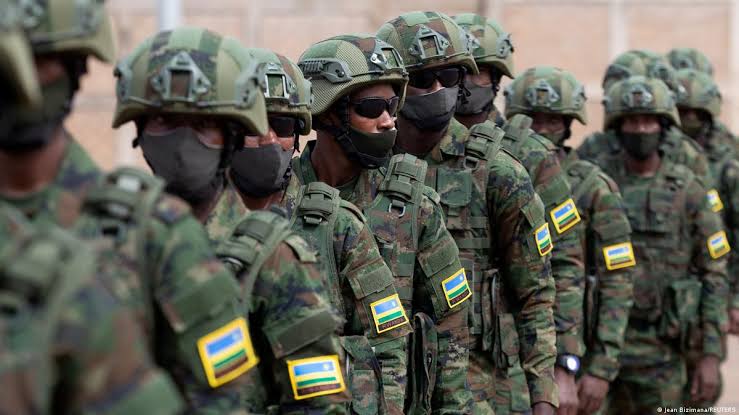
The United States government has imposed sanctions on the Rwanda Defense Force (RDF) and four senior Rwandan officials for alleged support to the March 23 Movement (M23) rebel group in eastern Democratic Republic of the Congo (DRC)—a move that could further strain relations in the volatile Great Lakes region.
The sanctions, announced by the U.S. Department of the Treasury’s Office of Foreign Assets Control (OFAC) on Monday, target Rwanda’s military establishment for alleged material, logistical and operational backing of M23, a group already under international sanctions for serious human rights abuses.
The RDF and the named officers are accused of providing critical support to M23, including training, equipment and battlefield coordination that has enabled the insurgents to seize territory in eastern Congo.
Analysts and UN expert reports have indicated that thousands of Rwandan troops operate within key rebel‑held areas alongside M23 fighters, significantly tipping the balance of power on the ground.
M23’s recent offensive saw the capture of strategic towns in North Kivu and South Kivu provinces late last year, contributing to a sharp deterioration in regional security and humanitarian conditions.
The insurgent group’s actions have been linked to mass displacement of civilians, extrajudicial killings and other abuses, prompting widespread international condemnation.
In December 2025, the rebels briefly captured the key port city of Uvira, further raising alarm about the conflict’s spread.
The sanctions seek to freeze any assets the RDF and the designated officials may have within U.S. jurisdiction and prohibit American individuals and companies from engaging in transactions with them.
U.S. officials say the action is meant to uphold a peace agreement signed last year, known as the Washington Accords for Peace and Prosperity, which was intended to usher in a cessation of hostilities and a withdrawal of foreign forces from Congolese soil.
Despite that accord, hostilities have persisted, with accusations that Rwanda’s backing of M23 violates the spirit of the pact.
In a statement accompanying the sanctions announcement, the U.S. government emphasised its continued support for peace and stability in the region and warned that sanctions enforcement could expand if Kigali does not alter its conduct.
The move follows renewed international calls, including a unanimous UN Security Council resolution in 2025,that Rwanda end all support for M23 and withdraw its forces from the DRC.
The targeted RDF officers include senior commanders whose roles have been linked to tactical operations alongside M23, a step that Western diplomats say has emboldened the rebels and enabled them to maintain control over large swathes of mineral‑rich territory in eastern Congo.
The region is a focal point for valuable resources including coltan and cobalt, which have economic and geopolitical importance beyond Africa.
Human rights advocates have praised the sanctions as a firm stance against impunity but warn that diplomatic pressures must be paired with genuine political engagement to achieve lasting peace.
With millions displaced and civilian suffering mounting, humanitarian agencies continue to call for increased protection and accountability measures, saying that sanctions alone will not end the cycle of violence.
Rwanda’s government has repeatedly denied direct military involvement with M23, framing its actions as defensive against security threats such as the Democratic Forces for the Liberation of Rwanda (FDLR), a militia group also active in eastern Congo. Kigali has maintained that it supports a negotiated solution and condemns abuses by any armed group.
However, evidence presented by U.N. experts and echoed by U.S. and regional officials suggests a more complicated and entrenched role for RDF elements in the conflict.
As the sanctions take effect, the international community is likely to closely watch Rwanda’s response and the broader impact on peace negotiations.
The U.S. move represents one of the most significant steps yet in using economic and diplomatic leverage to influence the dynamics of the long‑running Congo conflict.