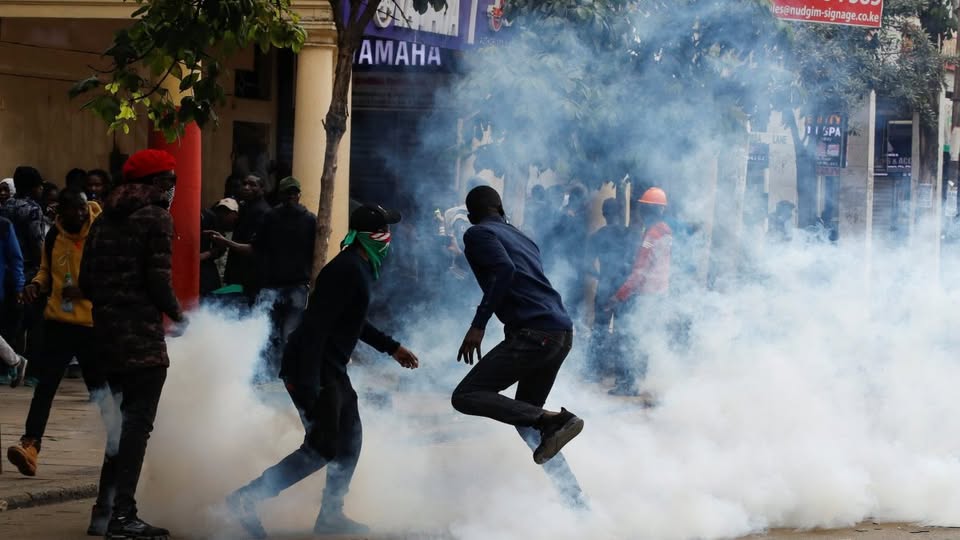
The streets of the capital took a decisive turn early Tuesday as thousands of demonstrators rejected the government’s recent attempts at price stabilization. While the National Treasury announced a last-minute VAT reduction to ease the burden of record-high fuel costs, the move has failed to calm public anger. Instead, the streets have become the staging ground for a broader debate on the cost of living, with protesters arguing that a marginal Sh10 reprieve is an insufficient response to a Sh40 price shock.
The “Drop in the Ocean” Relief
The current unrest follows an emergency intervention by the government intended to quell rising tensions. The National Treasury’s decision to reduce VAT on petroleum products from 13% to 8% resulted in a KSh 10 reduction per litre. However, in the eyes of many Kenyans, this is a “drop in the ocean” that only partially offsets the staggering KSh 40 increase previously imposed on Diesel by the Energy and Petroleum Regulatory Authority (EPRA).
Revised Pump Prices (Nairobi)
| Fuel Type | Initial April Price | Revised Price | Net Change |
| Super Petrol | KSh 206.97 | KSh 197.60 | – KSh 9.37 |
| Diesel | KSh 206.84 | KSh 196.63 | – KSh 10.21 |
Topic of Discussion: Why the Unrest Persists
The primary catalyst for the fuel price protest in Nairobi is the sentiment that energy remains historically and unsustainably expensive. Protesters and economic analysts alike are highlighting several key points of contention that keep the “maandamano” spirit alive.
The Rising Cost of Commuting
The most immediate impact of the fuel crisis has been felt in the public transport sector. In the wake of the EPRA announcement, Matatu operators across the city increased fares by between 20% and 30%. For a commuter traveling from Ruiru or Embakasi to the CBD, this translates to an extra KSh 40 to KSh 60 daily. Even with the government’s KSh 10 reduction, transport saccos have been slow to revise fares downward, citing the “high cost of spare parts and lubricants” which remain pegged to the stronger dollar and high energy costs.
Impact on Food Security
Manufacturers have warned that with Diesel still sitting near KSh 197, the cost of production for essential goods like maize flour and cooking oil will not see a corresponding drop. The ongoing fuel price protest in Nairobi is as much about the “unga” prices as it is about the pump. Farmers in the North Rift region, who are currently in the middle of the planting season, have also raised concerns that the high cost of diesel for tractors will inevitably lead to a more expensive harvest later this year.
The Burden of Taxation
While the state blames global supply disruptions caused by the Middle East crisis involving Iran and Israel, demonstrators are pointing to the high number of taxes and levies. Currently, taxes and levies comprise nearly half of the pump price in Kenya. Protesters are demanding a total overhaul of the Petroleum Development Levy and a further reduction of the VAT to the previous 5% level to provide genuine relief to the “Hustler” nation.
Current Situation on the Ground
The Nairobi CBD saw a heavy security presence throughout the morning, with police deploying tear gas to disperse groups near Parliament Buildings and the Treasury. Several major transport arteries, including parts of Mombasa Road and Thika Superhighway, reported intermittent disruptions as people joined the fuel price protest in Nairobi.
In the downtown areas of River Road and Luthuli Avenue, businesses remained partially closed as traders expressed fears of looting. Small business owners interviewed noted that their overhead costs have doubled since the beginning of the year, making it impossible to sustain profit margins without passing the cost to the already struggling consumer.
Security Outlook: Law enforcement remains on high alert across all major urban centers. Regional commanders have urged businesses to remain cautious, while civil society leaders maintain that the fuel price protest in Nairobi will continue until a more “people-centered” fuel stabilization fund is reinstated.