
The youth have urged the Ethics and Anti-Corruption Commission (EACC) to launch comprehensive, youth-centered investigations into corruption in public offices, arguing that graft continues to deny young Kenyans employment opportunities, fair access to procurement, and quality public services.
They are also calling for a thorough audit of all youth empowerment programmes and procurement frameworks at both national and county levels, saying initiatives meant to uplift young people have been captured by well-connected individuals and routinely manipulated through bribery and proxy companies.
In addition, the petitioners want stronger protection for youth whistle-blowers and anti-corruption activists, whom they say face intimidation, harassment and violence for speaking out. They further urged the commission to investigate corruption-linked killings and enforced disappearances of youth activists in collaboration with relevant agencies, warning that the country is sliding into a human rights crisis.
The demands are contained in a petition presented to the EACC by a group of youth who say they are frustrated by what they describe as entrenched corruption in public offices. The petition, received by EACC Chief Executive Officer Abdi Mahmud at the commission’s headquarters in Nairobi, was delivered on behalf of unemployed, underemployed and economically marginalized youth from across the country.
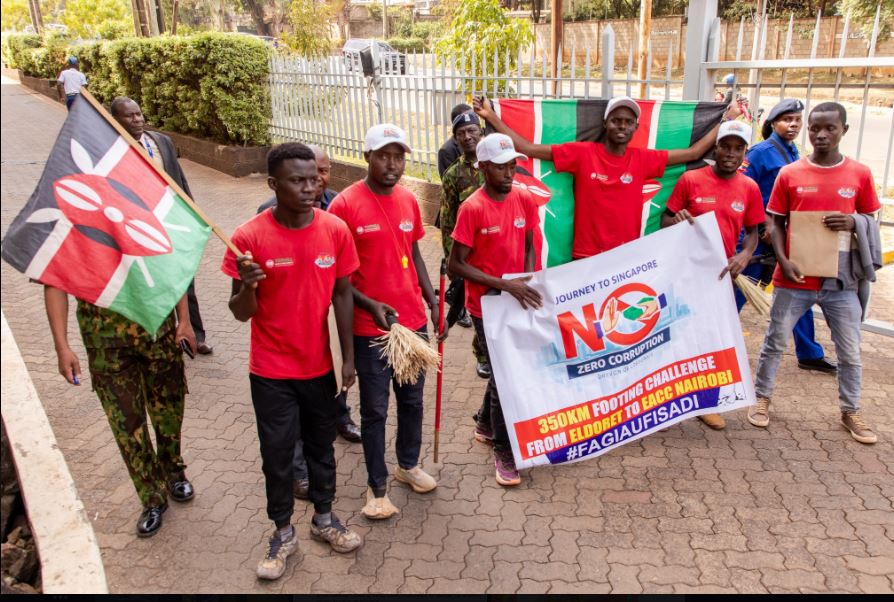
To underscore the urgency of their concerns, the group walked from Eldoret in Uasin Gishu County to Nairobi in a symbolic protest meant to highlight the gravity and desperation of their situation.
In their petition, the youth claim corruption has become systemic and transactional, characterized by bribery for employment in public service, kickbacks demanded for access to government tenders, and bribes required to obtain licences, permits and approvals. They also allege that procurement systems are routinely manipulated to favor politically connected individuals, while enforcement officers extort youth-owned businesses.
They argue that the situation has been worsened by the capture of state programmes intended to empower young people, including youth procurement preferences, affirmative action funds and enterprise grants. According to the petition, the initiatives are frequently hijacked by well-connected individuals, awarded to proxy companies linked to senior officials, or made conditional on bribes that genuine youth applicants cannot afford.
“As a result, youth without money to bribe the system are excluded, condemned to chronic unemployment, poverty and economic despair, crime, substance abuse and social breakdown as well as hopelessness and loss of faith in public institutions,” the petition states.
The youth further claim that the corruption crisis has evolved into a human rights issue, alleging that those who speak out or organize for accountability are subjected to arbitrary arrests, intimidation and threats. They also cite cases where anti-corruption activists have allegedly been killed under suspicious circumstances by individuals or networks fearful of exposure.
The petitioners fault oversight institutions for what they term selective investigations and political interference, which they say leads to delayed prosecutions and weak enforcement. This, they argue, has fueled a perception that anti-corruption action is reactive, selective and insufficient, further eroding trust in public institutions.
Receiving the petition, EACC CEO Abdi Mahmud said the commission would study the issues raised and take measures within its constitutional and legal mandate. He noted that EACC already has a memorandum of understanding with the National Youth Council and encouraged the petitioners to work closely with the council and other organized youth groups.
“Currently, we have an MoU with the National Youth Council, which we are implementing, and we encourage you to engage the Council and other organized youth groups to ensure the youth are at the centre of fighting corruption and promoting good governance in our country. Therefore, the petition is timely as it resonates with our strategic focus as a Commission in uniting the youth against corruption,” Mahmud said.